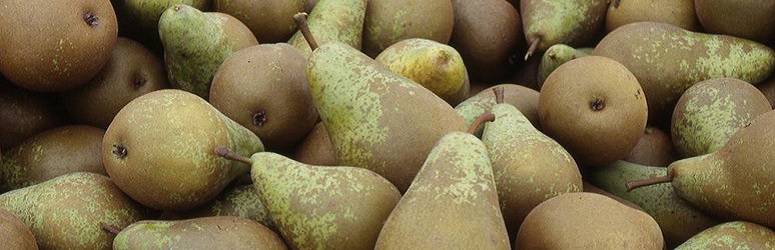
Perry is an alcoholic beverage made of fermented pear juice using a similar process as that for apple cider. Perry pear varieties come from France and England and often contain higher tannins and acids than dessert pear varieties. In Britain, perry is limited to no more than 25% apple juice, however pear cider may be a blend of apple and pear juice. Sparkling perry is sometimes known as champagne perry and has excellent flavor and quality.
History of Pears and Perry
Palladius, in the 4th century, wrote that the Romans preferred wine made from pears to that from apples. He also gave instructions on how to make perry. In medieval times, France was known for producing the best pears, and many varieties were brought to England after the Norman Conquest in 1066. However, wild or hedge pears continued to be grown in rural areas, and these pears were often used for making perry. Gradually regional farmers identified pears that were best in their areas for perry making, and in the late 1800s, enthusiastic researchers identified and described specific varieties, most of which are still known and used today. The Herefordshire Pomona published from 1876-1885 includes a chapter on the establishment of cider and perry factories by the Rev. Charles Bulmer: his son, H.P. Bulmer, founded the famous English cider making firm in 1887. Development and selection of improved varieties has continued to the present day, conducted by both private and state sponsored research programs.
Perry pear research at WSU Mount Vernon NWREC 2019 Summary
Introduction
Pears grow well in the mild maritime climate and are more tolerant of wet soils than most other tree fruits. Historically, perries were noted for their fine quality and full flavor. Perry pears, unlike cider apples, contain a proportion of unfermentable sugars such as sorbitol, which provides a residual sweetness to even the driest of perries.
Methods
To evaluate specific perry pear cultivars, a preliminary trial was planted in 2004, consisting of 1 specimen tree each of 15 cultivars (Table 1), grafted on the rootstock Old Home X Farmingdale 97. Source of the scion material was the National Clonal Germplasm Repository in Corvallis, OR, which then included 22 cultivars of perry pears, from which 15 were selected as being likely to perform well in the Puget Sound climate. Trees were planted in a single row and those cultivars that produced sufficient fruit were pressed for juice. The juice was analyzed for pH, acid, tannin, specific gravity (SG), and soluble solids concentration (SSC, %), measurements that are significant in the fermentation process of perry making.
As part of the preliminary study, fruit of 3 common dessert pear cultivars was pressed in 2006, and a sample perry was produced. We tested the methods for perry making in aspects that might differ somewhat from those used in cider making. This preliminary study was ended in 2009 when the tree fruit horticulture program at Mount Vernon was closed. However, data from the juice analysis of perry pears continued to be collected from those perry cultivars that produced sufficient fruit for pressing. Where sufficient fruit was available, fruit was pressed, juice analysis performed, and the juice fermented into perry.
Results and Discussion
Perry samples that were produced from standard dessert pears in 2006 demonstrated that even without the addition of perry pears, a good quality perry can be produced from dessert pears grown in local area orchards. A blended perry was made with standard dessert pears in 2006 (Comice, Conference, and Concorde), and with perry pears in 2012 (Barland, Barnet, and Butt). Single-varietal perries were made in 2013 (Barnet, Hendre Huffcap), 2014 (Normannischen Ciderbirne, Romania Perry), and 2017 (Barland, Butt).
Acknowledgements
Financial support for this study has been provided by the Northwest Cider Society, Northwest Cider Association, and the Northwest Agricultural Research Foundation. Local nurseries have donated trees and materials; their contributions are gratefully acknowledged.
References
Brooks, R.M. and H.P. Olmo. 1997. Register of Fruit & Nut Varieties, 3rd Edition. ASHS Press,
Alexandria, VA
Morgan, J. 2015. The Book of Pears, Chelsea Green Publishing, Inc., White River Junction, VT.
National Clonal Germplasm Repository – Corvallis Pyrus Catalog, NCGR Corvallis, 33447 Peoria Road, Corvallis, OR. http://www.ars.usda.gov/SP2UserFiles/Place/53581500/catalogs/pyrperry.html (Accessed 4/16/2019).
Table 1. Perry pears cultivars planted in 2004 at WSU Mount Vernon NWREC (includes descriptive information from NPGS, Corvallis, OR).
| Cultivar | Origin | Comments |
|---|---|---|
| PI 541123 Barland Bloom1: 4/24 (4/16 OR) Harvest2: 9/26 (9/19 OR) | Traditional English cultivar grown since before 1674. | Early-mid season; high acids and tannins. |
| PI 541124 Barnet Bloom: 4/23 (4/13 OR) Harvest: 9/22 (9/19 OR) | Grown south of Gloucester England in the 1800s; propagated and distributed by Long Ashton Research Station, Bristol, England in the early 1900s. | Early-mid season, scab-resistant, low acids and tannins. |
| PI 541151 Blakeney Red Bloom: 4/11 (4/14 OR) Harvest: (10/13 OR) | Traditional English cultivar, widely planted in the early 1800s. | Mid-season, moderate acids and tannins. A heavy and reliable cropper; slow to come into bearing. Fruit must be at proper maturity to produce an acceptable perry. Has a reputation for making a second-rate perry as fruit quickly becomes over-ripe. |
| PI 541156 Butt Bloom: 4/18 (4/18 OR) Harvest: 9/22 | Traditional cultivar from Gloucestershire and Herefordshire regions of England, widely planted during the 1800s. | Late season, moderate acids and tannins. Excellent keeping quality prior to milling; heavy producer but tends toward biennial bearing; slow to come into bearing; some fruit scab. Notable for length of time the fruit will lie on the ground without rotting. |
| PI 483365 Gelbmostler Bloom: 4/19 (4/9 OR) Harvest: 9/19 (10/3 OR) | Recorded in 1854 by German pomologist Lucas; known since the 18th century in Austria and northern Switzerland. | Its name means “yellow möst pear,” i.e. for making into perry |
| PI 541195 Gin Bloom: 4/19 (4/10 OR) Harvest: 9/19 (10/3 OR) | Traditional English cultivar from the Newent district of Gloucestershire. | Late season, scab-resistant, moderate acids and tannins. |
| PI 541205 Hendre Huffcap Bloom: 4/21 (4/9 OR) Harvest: 9/16 | Traditional old English cultivar from the Bromsberrow and Haresfield districts of Gloucestershire. | Mid-season, medium acids and low tannins; easily shaken from tree. The name Huffcap may have come from a potent ale that could “lift one’s cap,” or possibly from an alternate spelling “Huffcup” referring to lifting your cup when making a toast. |
| PI 231806 Normannischen Ciderbirne Bloom: 4/19 (4/14 OR) Harvest: 9/6 | Normandy, France; grows widely in Normandy and upper Austria. | Scab resistant. |
| PI 506378 Romania Perry Bloom: 4/22 Harvest: 9/23 | Romania; accessed from former Serbia and Montenegro. | Matures mid-Sept, fruit small, yellow, used for brandy. |
| PI 541261 Schweizer Wasserbirne Bloom: 4/19 (4/9 OR) Harvest: 9/2 (9/5 OR) | Thurgau region if Switzerland on the southern borders of Lake Constance; an area famed for its orchards. Recorded in 1823. | Name means “water pear,” produces a light perry; trees are very hardy, extremely vigorous and stately. Fruit undergoes practically no softening during ripening. |
| PI 541271 Taynton Squash Bloom: 4/18 (4/9 OR) Harvest: 9/2 (9/5 OR) | A very old English cultivar grown in the West Midlands since before 1700. | Early season, medium acids and tannins; does not store well. Mature tree is medium to large with narrow crotch angles, twiggy; very productive but usually biennial bearing; early flowering; fruit scab often severe. |
| PI 483367 Theilersbirne Bloom: 4/16 (4/11 OR) Harvest: 9/14 (8/28 OR) | Kanton Luzern area of Switzerland; very old perry pear (mostbirne). | Early ripening, mature at the beginning of September in Switzerland. |
| PI 541273 Thorn Bloom: 4/16 (4/11 OR) Harvest: 9/14 (8/28 OR) | A very old English cultivar grown since the 1600s. Trees are scattered throughout England’s perry growing districts; particularly common in northwest Gloucestershire. | Early-mid season, medium acids and low tannins. Ripens early September in western Oregon; very productive, but slow to come into bearing; fruit scab often present. Was once widely planted for dessert and culinary purposes for which it is now considered too astringent. Popular on account of its compact habit and heavy cropping. |
| PI 541486 Winnals Longdon Bloom: 4/15 Harvest: 9/10 | Raised by Mr. Winnall of Woodfield, England, in the parish of Weston-under-Penyard about 1790. | Mid-season, scab-resistant, high acids and low tannins. Ripens early September in western Oregon; tree is medium to large, very productive but tends toward biennial bearing; slow to come into bearing. One of the few English perry pears compatible with quince rootstock; relatively free of fruit scab. |
| PI 541287 Yellow Huffcap Bloom: 4/23 (4/8 OR) Harvest: 9/21 (9/26 OR) | Traditional old English cultivar; may be the original Huffcap pear from which the others were derived. | Mid-season, high acids and low tannins. The Huffcaps are a related group of cultivars with a distinct elliptical shape, protruding calyx end, and capacity for producing a strong perry. Ripens mid-September in western Oregon; must be shaken before ripe to prevent rotting on the tree. Very productive, but biennial bearing, slow to come into bearing; early flowering. |
2Harvest date is an average of dates recorded at WSU Mount Vernon NWREC 2012, 2013, 2014, 2016; harvest dates from Corvallis, OR in parenthesis, compiled from detailed accession observation pages online.
Table 2. Full bloom dates for perry pears tested at WSU Mount Vernon NWREC from 2013 to 2017, listed by cultivar.
| Cultivar | 2013 | 2014 | 2015 | 2016 | 2017 | Average |
|---|---|---|---|---|---|---|
| Barland | 5/2 | No bloom | 4/16 | 4/15 | 5/3 | 4/24 |
| Barnet | 5/2 | 4/21 | 4/16 | 4/10 | 5/5 | 4/23 |
| Blakeney Red | No bloom | 4/21 | 4/4 | 4/1 | 4/19 | 4/11 |
| Butt | 5/2 | 4/21 | 4/16 | 4/4 | 4/19 | 4/18 |
| Gelbmostler | No bloom | No bloom | No bloom | 4/15 | 5/5 | 4/25 |
| Gin | 4/28 | 4/21 | 4/10 | 4/4 | 4/30 | 4/19 |
| Hendre Huffcap | 5/2 | 4/21 | 4/10 | 4/4 | 4/30 | 4/21 |
| Normannischen Ciderbirne | No bloom | 4/21 | 4/16 | 4/4 | 4/20 | 4/19 |
| Romanian Perry | 5/2 | 4/21 | 4/20 | 4/4 | 5/3 | 4/22 |
| Schweizer Wasserbirne | 5/2 | 4/25 | 4/6 | 4/4 | 4/30 | 4/19 |
| Taynton Squash | 5/2 | No bloom | 4/16 | 4/4 | 4/20 | 4/18 |
| Thierlersbirne | 4/28 | 4/25 | 4/6 | 4/4 | 4/19 | 4/16 |
| Thorn | No bloom | No bloom | No bloom | 4/4 | 4/28 | 4/16 |
| Winnals Longdon | 4/26 | 4/21 | 4/6 | 4/4 | 4/20 | 4/15 |
| Yellow Huffcap | 5/2 | 4/21 | 4/16 | 4/13 | 5/5 | 4/23 |
Our pages provide links to external sites for the convenience of users. WSU Extension does not manage these external sites, nor does Extension review, control, or take responsibility for the content of these sites. These external sites do not implicitly or explicitly represent official positions and policies of WSU Extension.