Mechanical Hedging
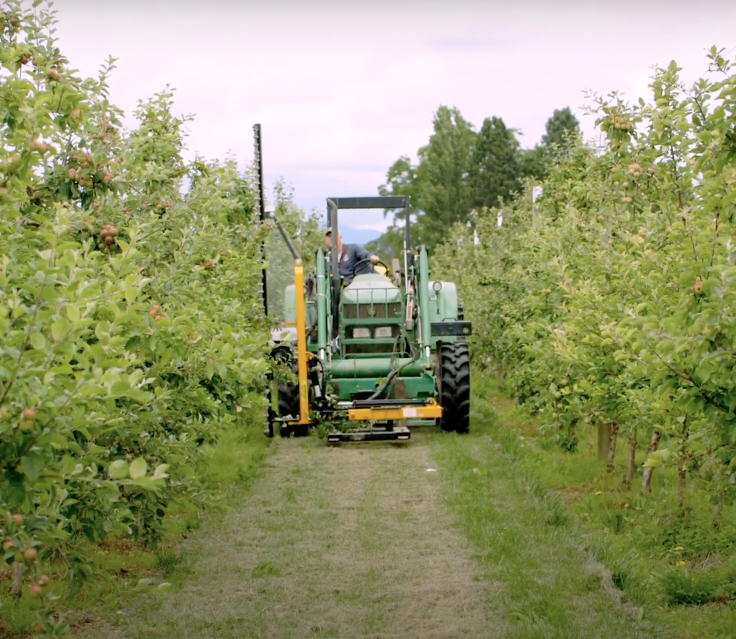
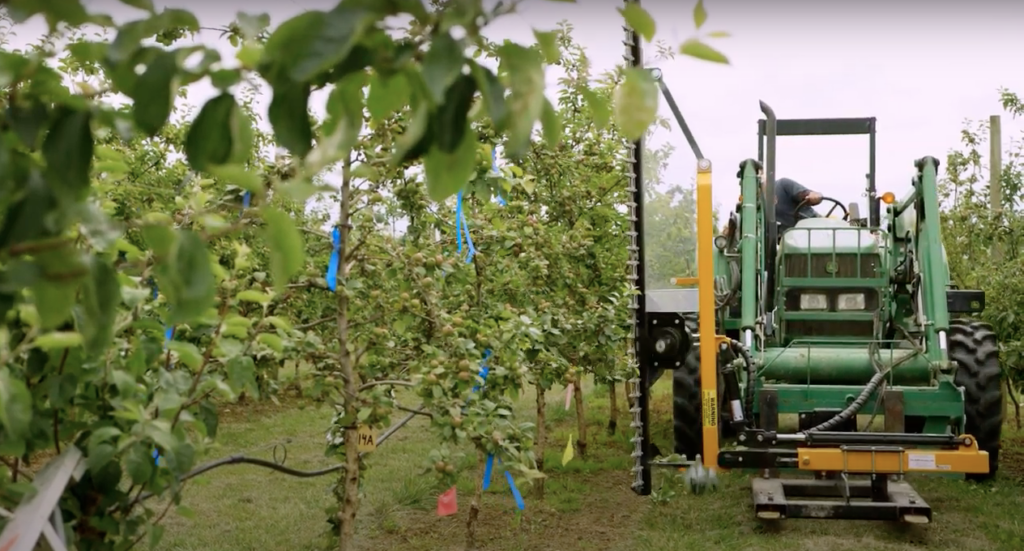
Mechanical hedging is a form of non-selective pruning, which has been demonstrated to reduce labor hours in commercial orchards. Mechanical hedging is particularly suitable for modern tree fruit orchards that are planted medium to high density using dwarfing rootstock and fruiting wall architecture training systems.
Mechanical hedging can reduce the need for summer hand pruning, but also serves to sculpt a narrow and open canopy suitable for other mechanized management practices such as mechanical harvest. Some hand pruning may be necessary if long branches persist within the row outside of the hedger path. Selective hand pruning in the dormant season (e.g. February) is needed to remove old wood.
Though popular in European orchards, mechanical hedging is not yet widely used in the United States and is being studied for labor efficiency and effectiveness on different apple bearing habits.
Based on research at WSU Mount Vernon NWREC, the average time to hedge both sides of a single row can be approximately twice as fast as hand pruning.
Video: Hedging the cider apple orchard at WSU Mount Vernon Northwestern Washington Research and Extension Center. Content by Dr. Carol Miles, Aidan Kendall & Ed Scheenstra. Video by Scott Calvert & Aidan Kendall.
Mechanical Harvest
Reducing the costs of harvest labor is a major concern for many producers of agricultural crops, and cider apples are definitely among those with high potential for innovation. Many cider apple varieties have small fruit, compared to standard dessert apples, so it can take as much as 4 times longer to hand-pick a bin of cider apples. However, unlike fruit intended for the fresh market, fruit for cider is usually pressed shortly after picking, so any fruit damage resulting from mechanical picking is of little concern.
Modified Over-the-row Tree Fruit Harvester
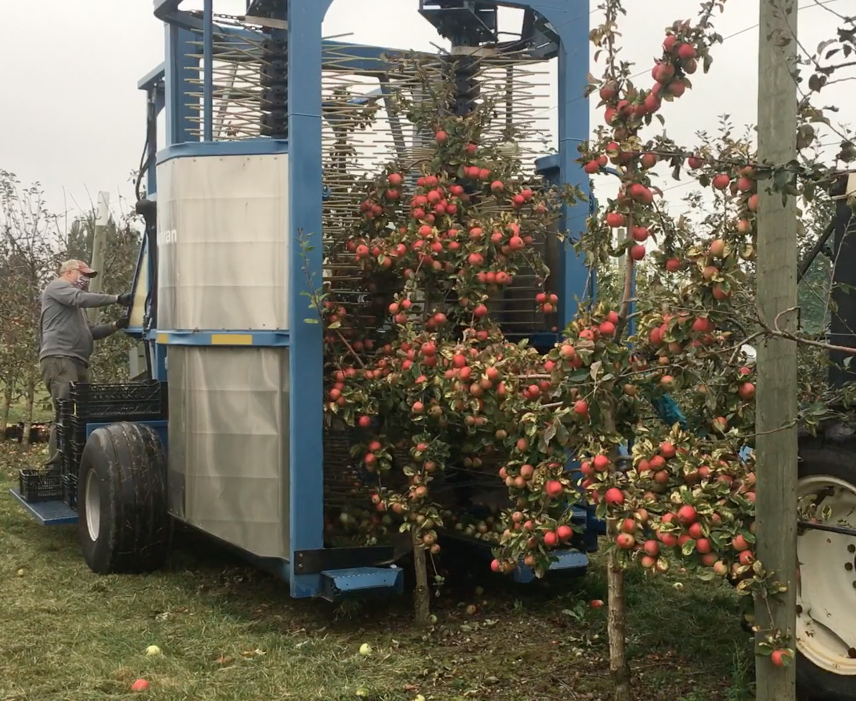
WSU’s Oxbo Korvan 930 harvester was modified in Michigan by Ken Engle of Left Foot Charley Cider to harvest cider apples. This tree fruit harvester is designed for high density orchards on dwarfing rootstock using slender spindle architecture training systems, with maximum tree height of 10 ft and canopy width of just less than 3 ft.
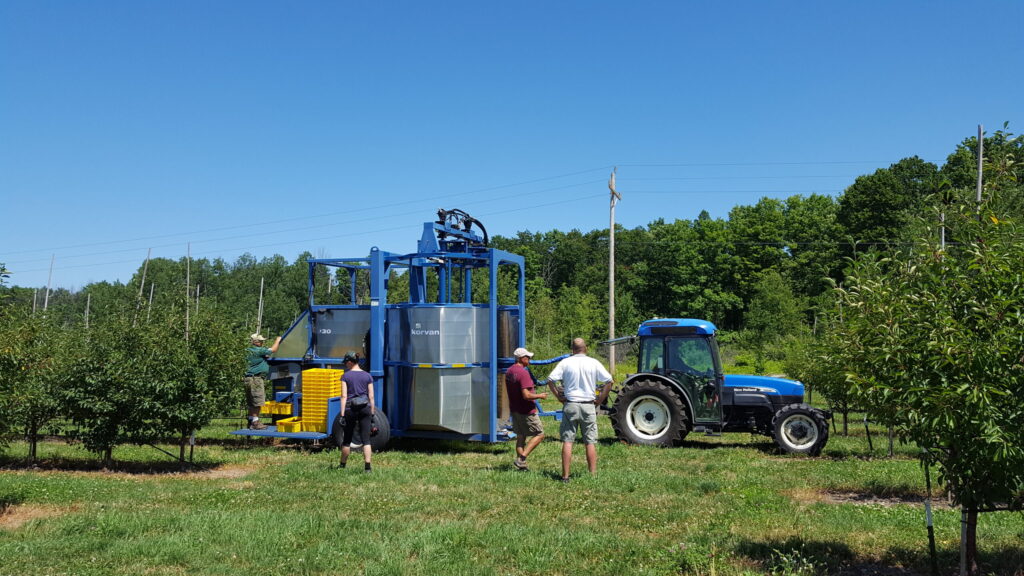
Photo: Left Foot Charley cider, Traverse City, MI
Our current high density research orchard was planted in 2014 and 2016, and was designed for mechanized management. Further research will evaluate plant growth regulator effects on reducing pre-harvest fruit drop as well as loosening stems to increase harvest efficiency. See footage from our preliminary trial harvesting this orchard at WSU Mount Vernon NWREC
Over-the-row Small-Fruit Harvester
Small-fruit harvesters are common in western Washington, where raspberries and blueberries are widely planted crops. At the time of cider apple harvest, berry season is over and the harvesters are available for use in picking cider apples. Crab apples, which have small fruit, planted on dwarfing rootstocks are well suited to picking with a small fruit harvester.
In our study, a cider apple planting was established on a low trellis in 2002, with trees grafted to strongly dwarfing rootstocks M27 and M9. From 2011 to 2016, replicated trials were conducted using a mechanical raspberry harvester (Littau Model OR0012) and two post-harvest storage treatments (0, 2, and 4 weeks cold and ambient storage) to examine the possible effects of harvest method.
European Mechanized Harvest Systems
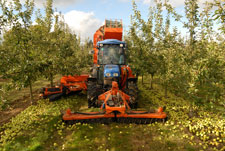
Mechanized harvest systems for cider apples have been common in Europe for years. Many traditional cider orchards in England and France are made up of large trees on vigorous rootstocks, free standing and widely spaced. At harvest time, tree shakers knock down the ripe fruit, which is then swept from the ground into a mechanized collector, often equipped with blowers to remove leaves and debris, and loaded into bins. Mechanical harvest technology uses methods designed for varying tree sizes and spacings, farm scale, and grower needs.
Our pages provide links to external sites for the convenience of users. WSU Extension does not manage these external sites, nor does Extension review, control, or take responsibility for the content of these sites. These external sites do not implicitly or explicitly represent official positions and policies of WSU Extension.