Establishing a Semi-freestanding Cider Apple Orchard
Establishing a Semi-freestanding Cider Apple Orchard
Authors: T. Alexander, M. Walden, J. King, E. Scheenstra, and C. Miles
Publication Date: January 2020
Affiliations: Washinton State University NWREC
Cultivars and Rootstock
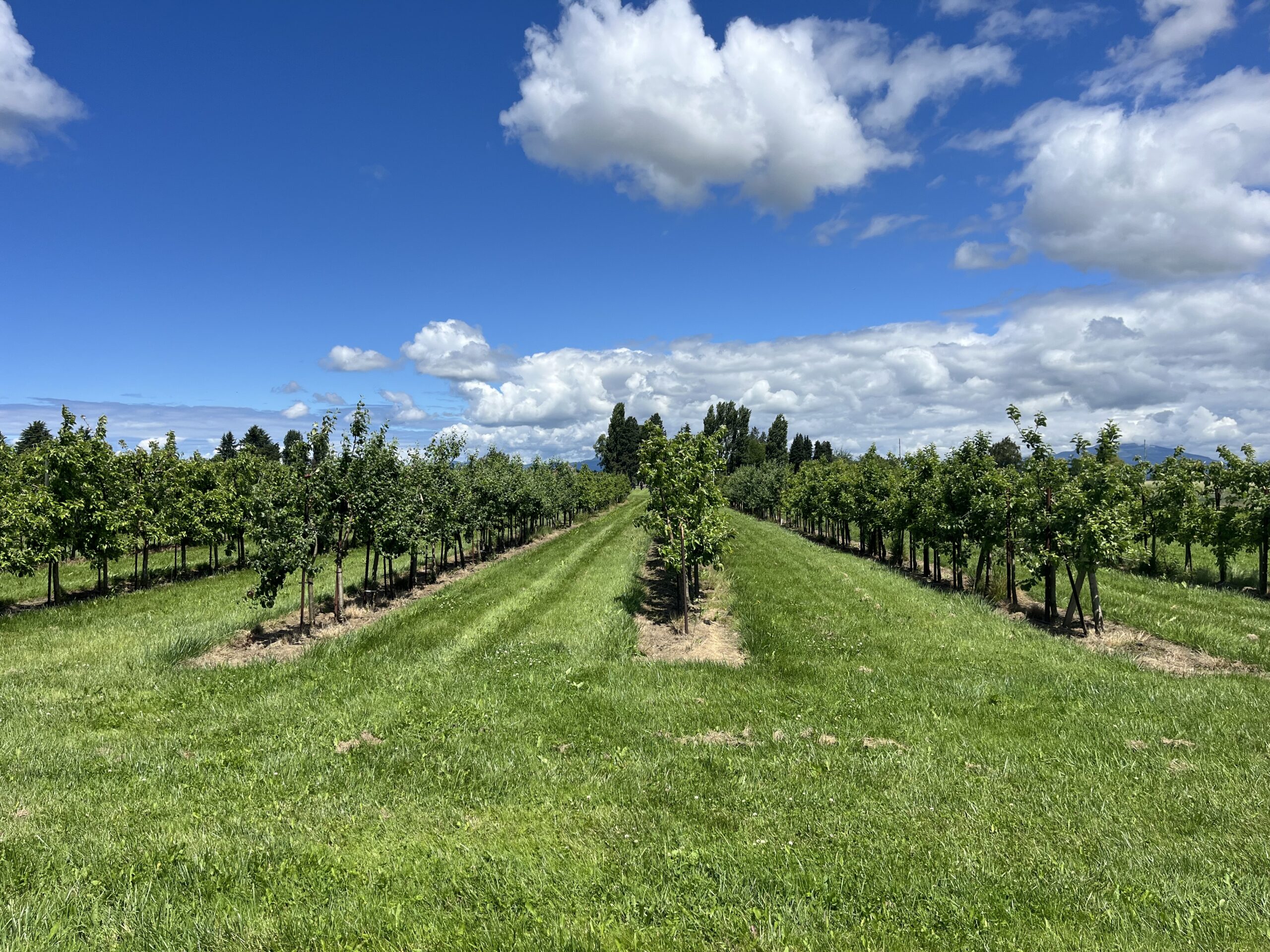
Two small cider apple research blocks were established at WSU Mount Vernon NWREC in 2016-2017, and we used this opportunity to test two different support stakes for the trees. Our goal was to determine if trees could be established in a medium density orchard (726 trees per acre) on dwarfing and semi-dwarfing rootstock with semi free-standing support (without a trellis system).
Block 1 consisted of Ashmead’s Kernel grafted on Geneva 11 (G.11) rootstock. Geneva 11 is a dwarfing rootstock that limits tree growth to 25% of standard size (8–12 ft.). The orchard contained 6 rows of Ashmead’s Kernal trees planted east and west, with a total of 16 trees per row. Spacing was 4 ft, in-row and 15 ft. between rows. The trees were planted in December 2016 – February 2017. Next to each tree, an 8 ft. long x 13 gauge rolled edge steel line posts (Linde Vineyard Supply, Monmouth, OR) was set 2 ft. in the ground. Each tree was secured to a post with rubber ties.
Block 2 consisted of 3 cultivars, Dabinett, Golden Russet, and Porter’s Perfection, grafted on Geneva 202 (G.202) rootstock and planted in April 2017. Geneva 202 is a semi-dwarfing rootstock that produces trees of around 40% standard size (10–14 ft.). The block included 6 rows with 48 trees per row, with spacing of 4 ft. in-row and 15 ft. between rows. Next to each tree, a 6-ft. bamboo stake 5/8 in. diameter was set 2 ft in the ground and secured to the tree with rubber ties.
Wind Damage
Daily wind speed at the orchard site averaged 3.7 mph from January 1 to October 31 in 2018, but in November 2018 a windstorm swept the area. For the first three days of November, wind speed averaged 8.6 mph with sustained winds of 10 mph and above, and wind gusts of 20 mph were recorded for 12 hours with peak wind gusts of 29.6 mph and 27.5 mph on 1 and 3 November, respectively. On 2 November, winds dropped to 6 – 9 mph with gusts of 18.5 mph. Daily rainfall during these wind events increased to 0.60 inches on average, in contrast to 0.08 inches daily total average precipitation from January 1 to October 31 (data from AgWeatherNet).
Trees of Dabinett on G.202 rootstock were observed to be bending up to 45 degrees (Fig. 1). This appeared to be caused by the strong winds in combination with saturated soil conditions. Sustained wind time also appeared to be a factor, because although summer wind gusts can be quite high, they are usually of short duration, whereas winter windstorms tend to produce high wind conditions for several hours. Also, a factor is the wind resistance posed by the tree canopy. When the leaves drop in the autumn, wind resistance is reduced, leading to less wind damage of the trees.
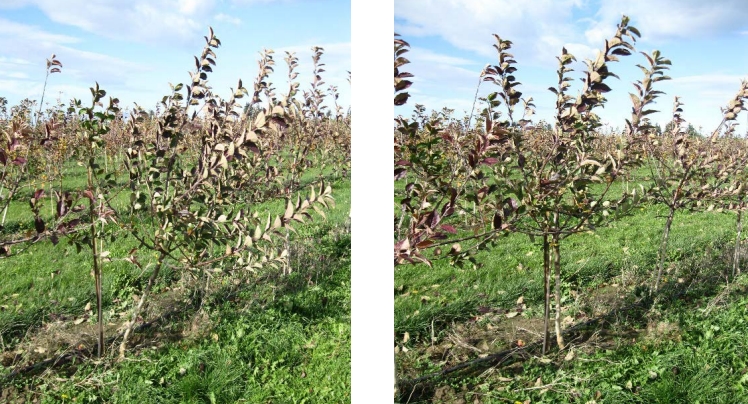
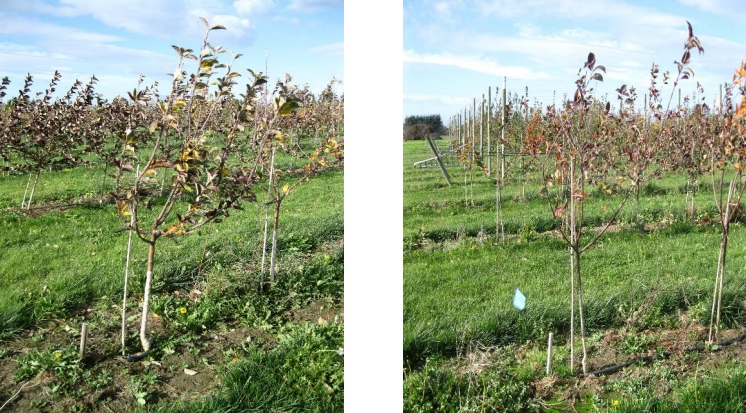
The bamboo poles installed at planting proved too flexible and shallow to prevent damage to the Dabinett trees on G.202 rootstock. Porter’s Perfection and Golden Russet on G.202 rootstock planted within the same block did not exhibit any damage (Fig. 2). These two cultivars had less vigorous top growth than Dabinett and so were less susceptible to the wind. To avoid uprooted or snapped trees, we installed the same 8 ft. long steel line posts as used in the Ashmead’s Kernel block for all trees in this block.
Conclusion
Based on this experience, we do not recommend bamboo poles as the sole supporting infrastructure for trees grafted to G.11 and G.202 rootstock (8–14 ft. grafted height) in areas where high sustained winds and/or oversaturated soils are a factor. The steel line posts used in this study supported and protected trees well throughout high winds.