Mechanization of Production
Yield and Labor Time for Mechanical and Hand Harvested Cider Apples
Authors: S. Brawner1, A. Kendall2, L. Kalcsits3, and C. Miles1
Publication Date: 2025
Affiliations: Washington State University (NWREC)1, Highland Economics LLC2, Washington State University (TFREC)3
Introduction
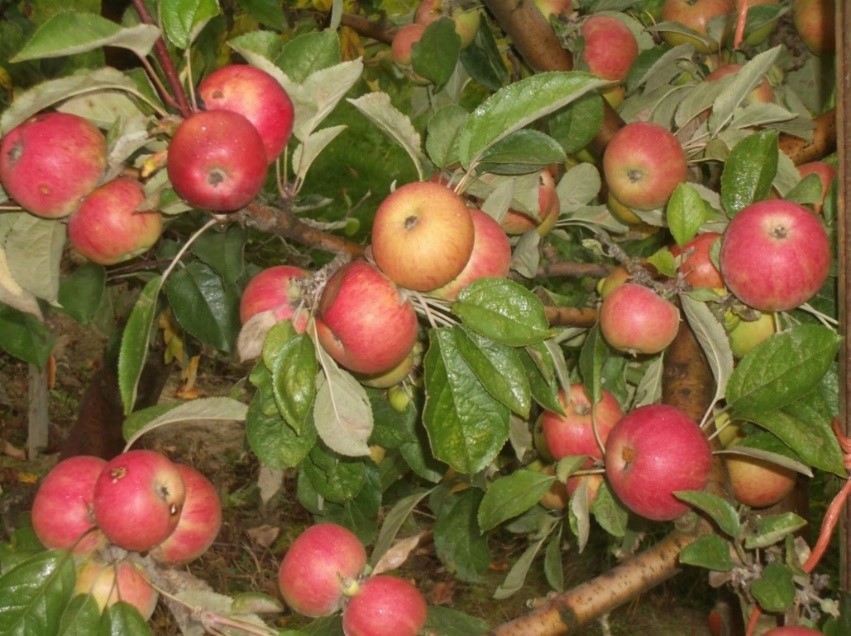
Cider apples (used for fermented, hard cider) are hand harvested in the U.S. whereas in Europe they are mechanically harvested to reduce production costs. European mechanical harvest shakes trees to knock fruit to the ground and sweeps fruit up from the orchard floor. These shake-and-sweep harvest systems have been developed for free-standing cider apple orchards where average tree density is around 280 trees/acre, and orchards tend to be located in regions with poor soil where dwarfing rootstock do not perform well.
In the U.S., cider apples are planted on dwarfing rootstocks with closer spacing (700 to 1450 trees/acre), higher yield and more precocity than free-standing orchards. Shallow-rooted rootstocks, relatively small trunk diameter, and narrow row spacing limit the use of the European mechanical harvest system. Additionally, while groundfalls can be used in hard cider production, fruit should be segregated in the harvest and processing lines for mixed operations (fresh and preserved fruit). It is important to note that fermentation has been shown to be an effective microbial kill step, reducing patulin levels significantly below the FDA guideline limit of 50 µg. L-1.
To address the need for mechanical harvest for U.S. cider apple production, researchers at Washington State University Mount Vernon Northwestern Washington Research and Extension Center (WSU NWREC) conducted a mechanical harvest study in 2021-2023. The fully mature orchard contained sixteen cider apple cultivars grafted on ‘Geneva 935’ rootstock, all of which were harvested using a modified Oxbo-Korvan 930 harvester.
Evaluating Mechanical Harvesting Suitability
Materials and Methods
Research Orchard. The research orchard near Mount Vernon, WA, USA was planted in 2014. The 0.35-ha orchard contained 16 cultivars of cider apple trees, spaced 1.8 m apart in-row, with 3.7 m between rows. Trees were grafted to ‘Geneva 935’ rootstock and trellised and trained to a 3.0 m tall vertical axis, with a central leader.
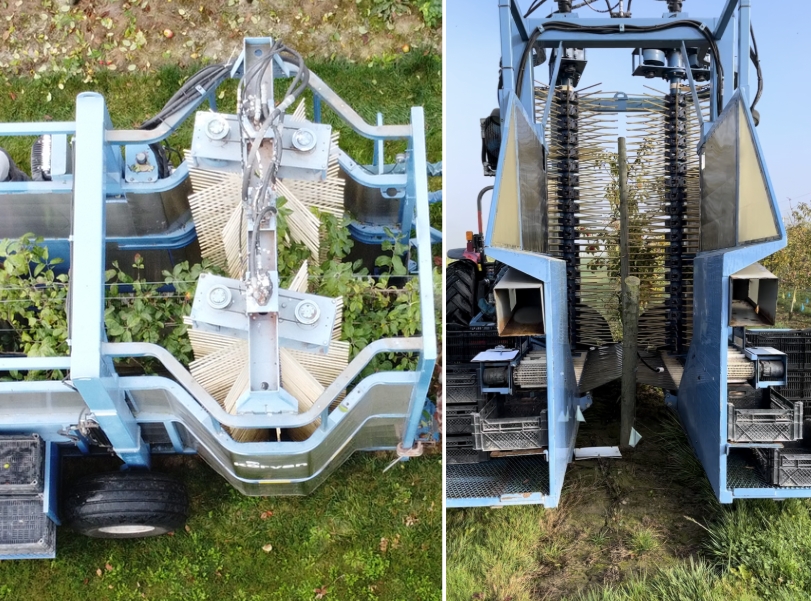
Mechanical Harvester. This experiment utilized an over-the-row Oxbo-Korvan 930 harvester (Oxbo International Co., Lynden, WA, USA;) modified only by increasing the tunnel height from 2.1 m to 3.7 m. The modified Oxbo-Korvan 930 includes heavy duty Dynarotor head and rods (48 cm length), which rotate at variable speeds that is based on contact resistance. A diesel tractor was used to pull the harvester (Fig. 1), with the PTO operating at 540 rpm and the tractor moving in the lowest gear moving at 0.31–0.35 m.s-1.
Experimental Procedures
Cultivars with high crop load and similar harvest dates were selected for the study each year. Due to the biennial bearing habit of cider apple cultivars, not all cultivars had sufficient fruit for harvest every year. All cultivars were harvested at least 2 years, and three cultivars were harvested all 3 years.
Chemical Applications. The orchard was sprayed with three commercial plant growth regulator products (ReTain, Valent Biosciences, Libertyville, IL, USA; Refine, Fine Americas Inc., Walnut Creek, CA, USA; Ethephon 2SL, ADAMA, Raleigh, NC, USA) at label rates prior to harvest all 3 years. Products were applied to retain fruit on the trees (ReTain and Refine) and then to release fruit (Ethephon) to maximize fruit capture by the harvester.
Harvesting. Each year, all plots were harvested on the same day. One tree per plot was harvested by hand prior to mechanical harvesting for hand vs mechanical time comparison.
Storage. All 3 years, mechanically harvested apples were stored at ambient temperature, and yield was measured within 3 d of harvest.
Measuring Yield. Number of lacerated fruit and mean number of fruiting spurs harvested were calculated per plot in 2022 and 2023. In 2023, the mean weight and diameter per fruit were calculated for each plot.
Results and Discussion
Yield. Overall, across years and cultivars, 82% of fruit were captured by the harvester. On average, 9% of fruit dropped to the ground during mechanical harvesting, with no difference seen between cultivars. Additionally, 9% of the fruit remained on the tree after mechanically harvesting across all cultivars. Most apples dropped by the harvester bounced out the front of the harvester or were shaken off before the harvester was positioned over the tree. Softening the surface of the catch plate would reduce the number of fruits bouncing out of the harvester. Extending the catch plates further in front of the harvester to catch apples would also increase the machine’s capture efficiency.
Time. The overall average time required to mechanically harvest one tree in this orchard was 5.3 s, averaging 2.9 s per row-meter traveled. The average time required to hand harvest one tree in this study was 229 s (3.8 min). The time to harvest one tree with the modified Oxbo-Korvan 930 was more than 40- fold less than by hand.
| Year | Time (s) per row meter traveled | Time (s) to mechanically harvest one tree | Time (min) to hand harvest one tree |
|---|---|---|---|
| 2022 | 3.1 | 5.7 | 4.46 |
| 2023 | 2.7 | 4.9 | 3.4 |
2In-row spacing was 1.8 m.
Spur Loss. Overall, 8.0 spurs were removed with fruit per tree during mechanical harvest, and there was a difference among cultivars. This amount of spur removal during mechanical harvest is minimal. However, longer term studies are needed to determine if cultivars with high spur abscission (like Sweet Alford) are suitable for over-the-row mechanical harvest.
Tree Damage. The overall average number of branches broken during mechanical harvest was 1.4 per tree, and there were no differences among cultivars. This number is considered minimal and could be further minimized by training new branches horizontally.
Bruising. All of the cider apples captured by the harvester were bruised. The larger the apple, the more lacerations from harvester damage. Lacerations serve as entry points for bacteria and fungi to cause decay, and thus, larger cider apples may not store as well as smaller apples after mechanical harvest. Yet after 15 d in cold storage, the greatest amount of fruit removed due to rot was ~4%, and was only ~6% after 32 d. Typically, if cider apples are harvested at maturity, they are pressed within a few days or weeks. Thus, yield loss due to fruit damaged due to mechanical harvest and developing rot would be minimal.
Conclusions
Mechanical harvest using the modified Oxbo-Korvan 930 required 40-fold less time than hand harvest. Picking efficiency of the modified Oxbo-Korvan 930 harvester could be increased from 82% to >90% with relatively simple harvester improvements, such as softening the catch plates surface and extending the catch plates in front of the harvester. Loss due to rot of mechanically harvested fruit during 32 d post-harvest cold storage was minimal (4–6 %) and juice quality did not decline. These results demonstrate that the modified Oxbo-Korvan 930 harvester is suitable for cider apples. More research is needed to assess yield and tree health following multiple years of mechanical harvest. Additionally, testing is needed to evaluate viability of over-the-row harvest in a commercial cider apple orchard setting.
References
S. Brawner, A. Kendall, L. Kalcsits, and C. Miles. 2025. Over-the-row mechanical harvest of cider apples (Malus domestica borkh). Horticulturae. DOI:10.3390/horticulturae11091123
Funding support was provided by Washington State University and the National Institute of Food and Agriculture Hatch projects 1017286 and 7001317. Technical assistance was provided by Edward Scheenstra and Adam Elcan.